
You explain and you let them experience
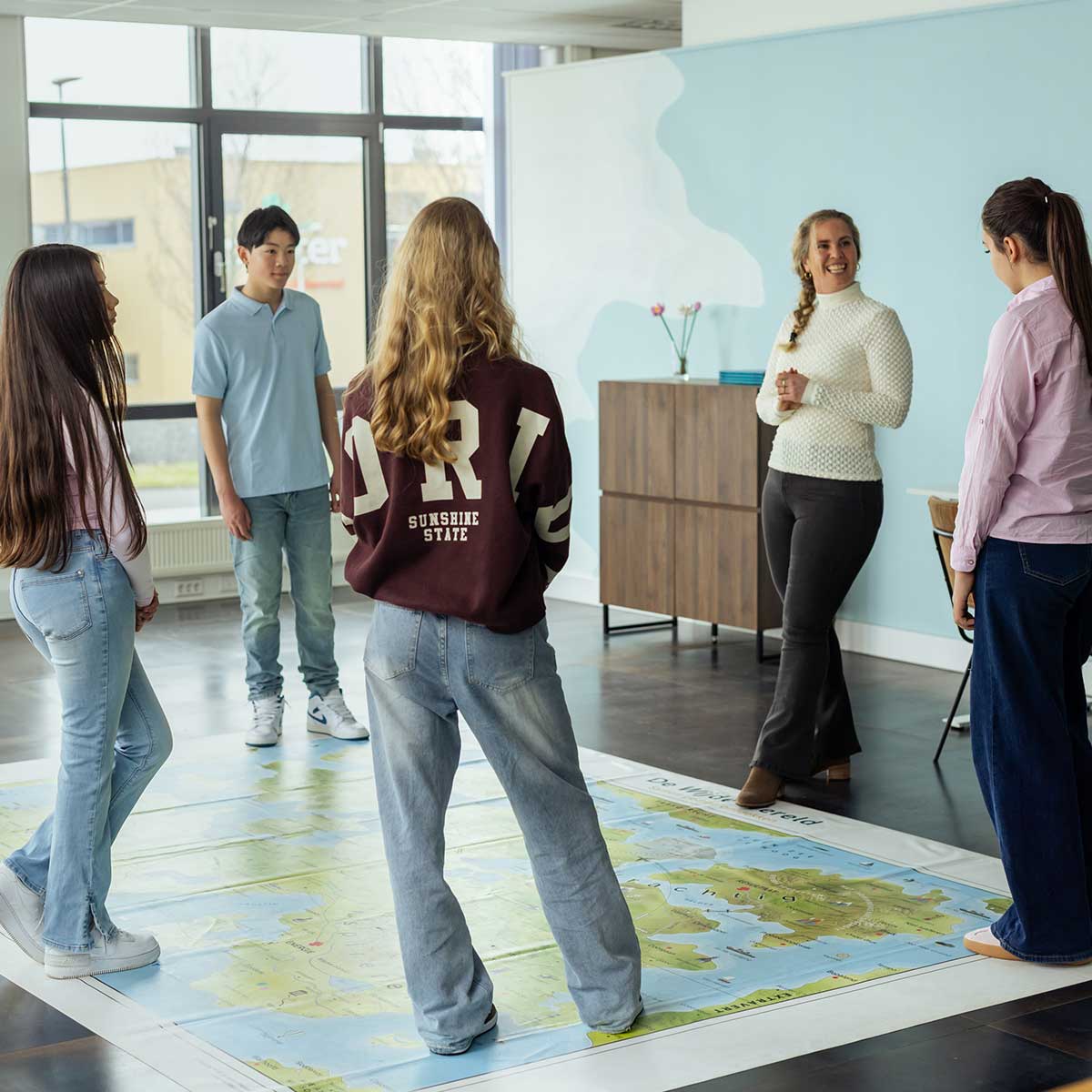
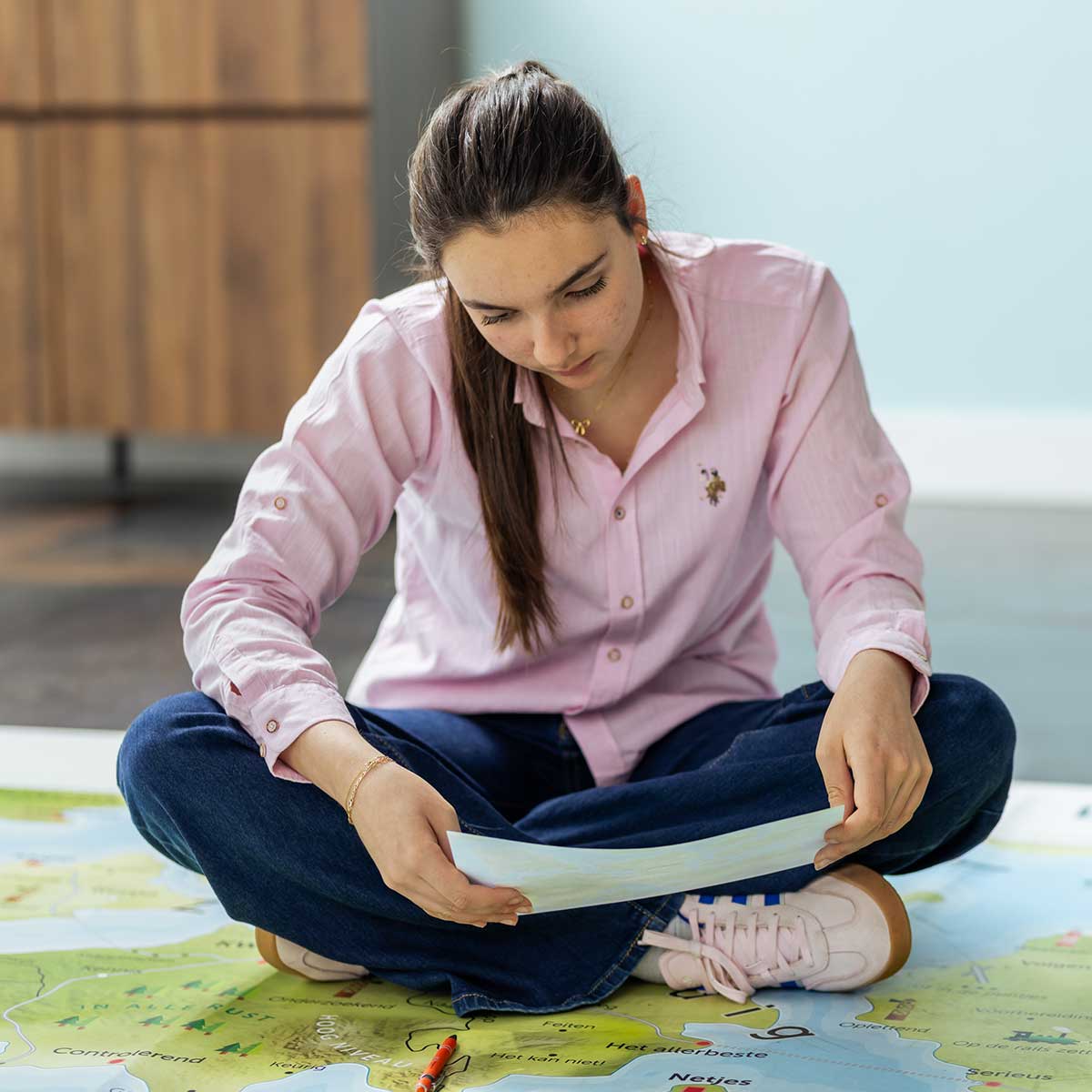
Teachers, form tutors and education professionals can certify as a Guide and then work with the map themselves. There is theory behind the map, and you pass that on too. But you start by doing: pupils or students step onto the Floormap and discover through talking how behaviour works. For young people from the age of twelve there is A World to Discover, which requires the additional YoungTalent Guide certification.
This is an ideal product for a guided classroom discussion. There is no right or wrong answer and the conversation goes where the pupil takes it. The Floormap makes pupils open to learning straight away and to having the conversation about behaviour with each other.
From a form period to an induction week or a project week in which a class or a team steps onto the map together, theMapsTell products give you as a teacher limitless possibilities. You have language for talking about working together, and that language belongs to the class itself.
Which version fits your audience?
Both maps do the same work, in a language that fits the group.
A World to Discover


The World of Difference
Three things pupils take away
At the start of a school year or with a new class,the map produces more self-insight and more insight into classmates in a shortspace of time. That helps pupils find each other faster.
“#GenerationEmpathy is our way of contributing to a generation that grows up with more self-knowledge, more understanding of difference and more connection.”
Our dream is to put every young person on the map.We do that with #GenerationEmpathy, together with certified Guides. Teachersand form tutors who work with A World to Discover are helping to build it.
- Heller Rompa, CEO of MapsTell
From Discovery Call to working in the classroom
Three steps from a first conversation to standing on the Floormap with your class. The order matters, and step two is the basis.
Step 2 - The Guide certification
You certify first with The World of Difference, through the Guide certification. It is delivered entirely online, at your own pace and with live sessions, and it is the basis for everything that follows.
Step 3 - The YoungTalent Guide
If you want to work with A World to Discover, the YoungTalent Guide certification follows. It is available as a follow-up training.
A Guide who facilitates the session for you
For a project week, a staff development day or an induction week you can also bring in a Guide to facilitate the session.

Frequently asked questions for teachers
Below you will find the questions we hear most often, with clear answers.
Do I need to be certified to use this in my classroom?
Yes. Working with the map requires certification, in education too. For A World to Discover you need the YoungTalent Guide certification, which you take as a follow up to The World of Difference.
From what age does this work?
From the age of twelve with A World to Discover. There is no upper limit: it works well in vocational education and with older young people too. A World to Discover works without a questionnaire and without a profile: young people step onto the Floormap together and discover how behaviour works as they talk.
Does this fit citizenship education?
Yes. Learning to deal with difference, understanding each other and making agreements together sit at the heart of citizenship. A World to Discover makes that concrete and discussable, in language pupils use themselves.
How much time does a session take?
That is up to you. Guides work with formats that fit within a mentor hour, but also with longer sessions during a project week or an induction period.
Can I use this without certifying myself?
Yes, by bringing in a Guide for a project week, a training day or an induction period. Many schools start this way and only then decide about certification.
Do pupils receive a profile or a result?
Not with A World to Discover, and that is a deliberate choice. Young people are still developing, and the map is a starting point for exploring together. In higher education the PersonalMap is used.

Tell us who you work with and we will look at which route fits
Secondary education, vocational education, highereducation or teacher training: the version and the route differ per age group.